







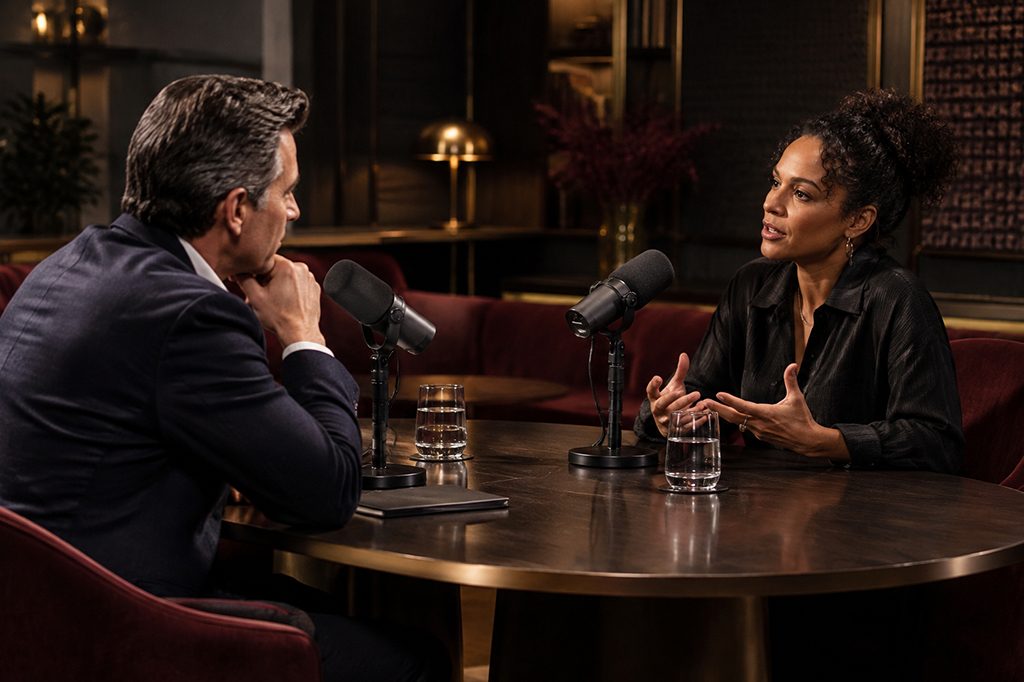
Some of the most useful business lessons don't come from a classroom or a business book. They come from listening to people who have faced uncertainty, made difficult decisions and learned from experiences that are very different from our own. That is one reason The FFTB Show brings together entrepreneurs, founders, healthcare professionals, business leaders and other changemakers for conversations that go beyond job titles.
A founder may have a lesson about resilience. A healthcare professional may offer a completely different perspective on responsibility and pressure. A business leader may explain how one difficult decision changed the direction of an organisation.
Different careers. Different challenges. Yet often, surprisingly similar lessons.
Business advice is everywhere.
There are podcasts, talk show books, courses, newsletters and social media posts offering answers to almost every professional problem. But information alone doesn't always tell us what it feels like to make a decision when the outcome is uncertain.
That is where real experience becomes valuable.
Listening to founder stories can reveal the mistakes behind successful companies, not just the milestones. An entrepreneur may talk about a product that failed, a partnership that didn't work or a period when growth became difficult.
Those moments are often more useful than a polished success story because they show how decisions are actually made.
Entrepreneurship is frequently presented as a journey from idea to success.
The reality is rarely that simple.
Most entrepreneurs deal with uncertainty, changing priorities, financial pressure, hiring challenges and moments when the original plan simply stops working.
The most useful entrepreneur stories are therefore not necessarily the ones with the biggest headlines. They are the ones that explain what happened between the beginning and the outcome.
What did the founder get wrong?
When did they change direction?
Who helped them?
What would they do differently today?
These questions turn an interview into something more meaningful than promotion.
Leadership is not limited to the boardroom.
A hospital leader may make decisions where people's wellbeing is directly involved. A technology founder may lead a team through constant innovation. A social entrepreneur may work with limited resources while trying to create measurable community impact.
The environments are different, but many leadership challenges overlap.
Communication, accountability, resilience, trust and decision-making matter almost everywhere.
This is why leadership stories can be valuable even when the audience has no connection to the guest's particular industry.
You may not work in healthcare, technology or finance, but you can still learn from how someone handles pressure, uncertainty or responsibility.
Healthcare offers a particularly interesting perspective on leadership.
Healthcare professionals regularly work in environments where decisions can have significant consequences, teamwork is essential and circumstances can change quickly.
The World Health Organization highlights the importance of investing in and strengthening the global health and care workforce, including leadership, education and workforce planning.
That makes conversations with healthcare professionals valuable beyond the healthcare sector itself.
Their experiences can raise questions that business leaders should also consider:
These are not only healthcare questions. They are leadership questions.
The difference between an ordinary interview and a memorable one often comes down to curiosity.
A good interviewer doesn't simply move from question one to question ten. They listen closely enough to notice something interesting and ask about it.
That can turn a prepared conversation into a genuine one.
The best entrepreneur interviews often reveal unexpected moments: an early failure, a mentor who changed someone's thinking, a difficult career decision or a lesson that only became clear years later.
Those moments make conversations human.
And that matters because audiences rarely connect with achievements alone. They connect with the person behind them.
A statistic can inform you.
A story can make you remember.
That is one reason the format of a talk show podcast can be powerful. Long-form conversations allow guests to explain not only what they achieved, but why they made certain choices and what those experiences taught them.
The World Economic Forum has also highlighted collaboration and cross-sector ecosystems as increasingly important to how organisations compete and respond to change.
Conversations can play a similar role on a smaller, more personal level. They allow ideas to move between industries and give audiences access to perspectives they may never encounter in their everyday professional lives.
You don't need to copy someone else's career to learn from them.
Instead, listen for principles.
Maybe a founder's story teaches you to test an idea before investing heavily in it.
Maybe a healthcare professional reminds you that good leadership starts with listening.
Maybe a business leader demonstrates why changing direction is not necessarily a sign of failure.
The useful lesson is often hidden beneath the story.
That's what makes The FFTB Show more than a collection of interviews. At its best, a conversation gives the audience something to think about after the episode ends.
We live in a time when everyone has an opinion and information moves incredibly quickly.
Taking the time to listen carefully has become a skill in itself.
The most valuable conversations don't always give us an immediate answer. Sometimes they give us a better question.
And a better question can change how we approach a business, a career, a team or even our own definition of success.
That is the real value of stories.
Not simply knowing what someone achieved, but understanding what they learned along the way.
The FFTB Show continues that idea through conversations with people from different backgrounds and industries, because sometimes the lesson we need most is waiting inside a story we never expected to hear.
Follow conversations featuring real startup stories, founder journeys, and global entrepreneur insights:
👉 YouTube
👉 Spotify
🔗 Explore more: https://thefftbshow.forttuna.com/
Author: Siddhi Kamath
Review Expert: Dr. Raul Handa, DBA